Most underperformance is not incompetence. It is misdiagnosis.
- We are quick to say:
- “Low ownership.”
- “Not proactive.”
- “Poor attitude.”
But what if the real issue is energetic imbalance?
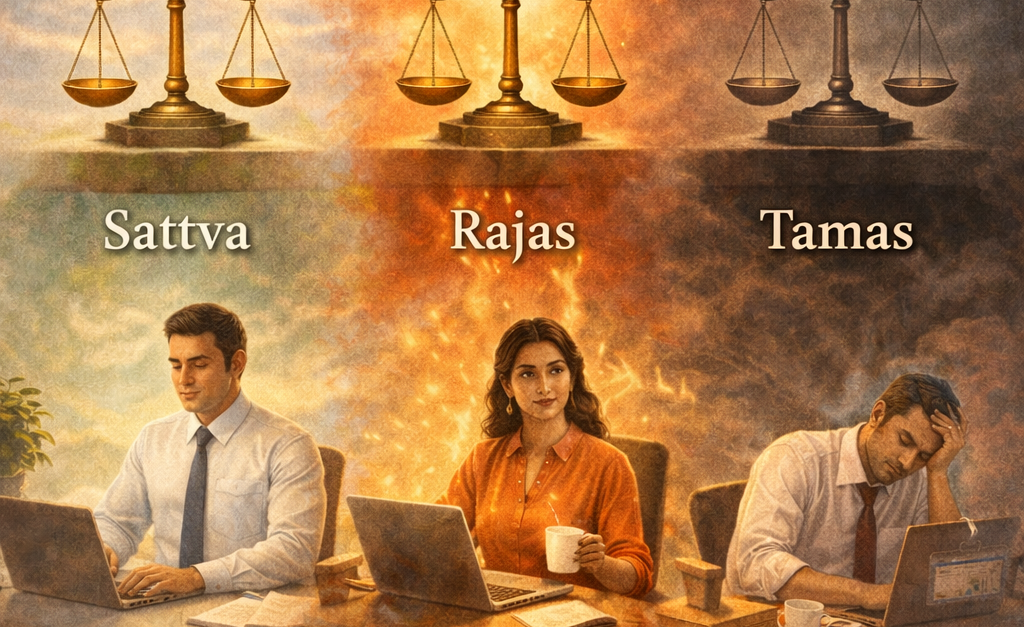
Indian knowledge systems have always recognised three fundamental forces shaping human behavior:
- Sattva → clarity, balance, ethical intent
- Rajas → drive, ambition, restlessness
- Tamas → inertia, confusion, withdrawal
These are not personality labels.
They are states. And states shift.
The problem?
Most companies use one motivation template for everyone.
That’s like giving the same fuel to a tractor, a race car, and a parked vehicle.
How Gunas Show Up at Work
🟡 Rajas in the Workplace: High energy. Competitive. Target-obsessed.
You’ll often see this in:
- Sales teams
- Startup founders
- Business development units
- Strength: Speed and results.
- Risk: Burnout, ego clashes, short-term thinking.
If you try to “calm them down” too much, performance drops.
If you don’t channel them, politics increases.
Motivation Strategy:
- Stretch targets
- Visible growth pathways
- Recognition systems
- Healthy competition
Rajas needs direction, not suppression.
🟢 Sattva in the Workplace
Calm productivity. Ethical clarity. Process discipline.
You’ll see this in:
- Operations
- HR
- Finance
- Compliance teams
- Strength: Stability and integrity.
- Risk: Under-recognition in flashy cultures.
Sattvic employees don’t shout. They build quietly.
Motivation Strategy:
- Autonomy
- Meaning-driven goals
- Clear systems
- Respect for their expertise
Sattva thrives when trusted.
🔵 Tamas in the Workplace
Disengagement. Confusion. Resistance.
This is not a “bad employee.”
This is a warning signal.
- Tamas builds when:
- Goals are unclear
- Leadership is inconsistent
- Politics outweighs merit
- Effort is not rewarded
Motivation Strategy:
- Structured routines
- Clear accountability
- Short-term wins
- Direct feedback
Tamas doesn’t need inspiration. It needs structure.
The Leadership Shift
Stop labeling people…. Start diagnosing states.
An employee who looks tamasic today may have been rajasic last quarter.
A high-rajas performer may collapse into tamas after burnout.
Leadership is not only target management. It is energy management.
- You cannot motivate everyone the same way.
- You cannot discipline everyone the same way.
- You cannot reward everyone the same way.
A wise leader balances the gunas within teams.
Too much Rajas? Culture becomes aggressive.
Too much Tamas? Culture stagnates.
Pure Sattva without Rajas? Vision without scale.
High-performing organisations maintain dynamic balance.
Practical Reflection for Leaders
Ask yourself:
- Which guna dominates my leadership style?
- Which guna dominates my team?
- Where is imbalance creating friction?
Because here’s the uncomfortable truth:
- Most HR systems measure output.
- Very few leaders measure energy.
And yet energy determines output.
If we truly want to rebuild work culture with depth, we must go beyond Western motivation theory and revisit frameworks rooted in our own civilisational psychology.
The workplace is not just a productivity engine.
It is a living energy ecosystem.
Lead the energy well | Results will follow.
If this perspective resonates, reflect in the comments: Which guna do you observe most in your workplace right now?